It was a dark and stormy night when I left the land of the big PX for Vietnam. I arrived in April 1969. Prior to getting to Vietnam I had talked to several people at the Processing Center at Ft. Lewis, Washington who had been in-county. They told me that the first thing you would notice was the smell.
Well, it wasn't the smell I first noticed as much as the HEAT. Our flight arrived at Cam Rahn Bay at about 0600. At 0605 I started to melt! The heat starts early in Vietnam. We were placed on buses at the airfield and were taken to the Replacement Center. On our drive I thought it unusual that there were Vietnamese civilians along the roadways inside the perimeter. But, oh well, at least they weren't shooting at us...yet...and of course there was steel mesh on the windows to keep us safe. (Really?)
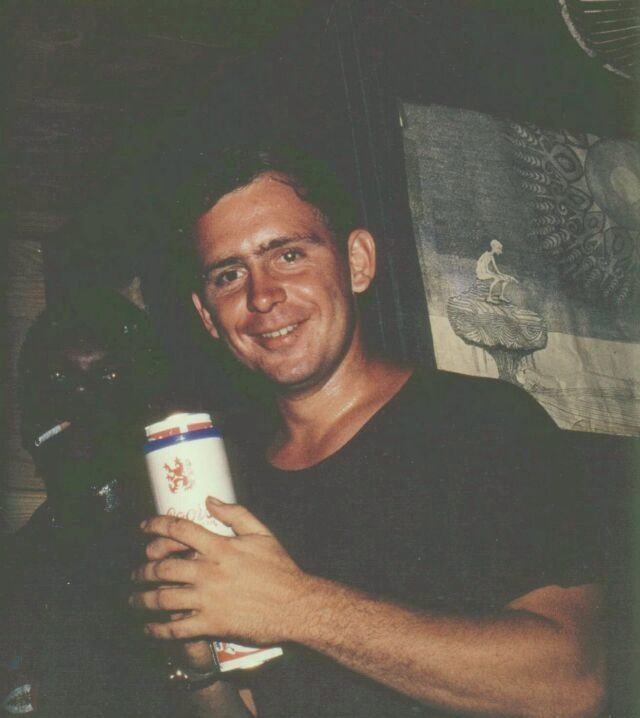 I was processed in-county, then I was assigned to the 23rd Infantry Division (Americal) at Chu Lai. Of course, not from being around there, I ask, "Where is or what is a Chu Lai?" I was simply told it was up north and I could find it on the map. Well I let my fingers do the walking and I finally did find Chu Lai (or Chicken Little as it was more often called). I thought, this isn't bad. It's on the beach. This is going to be a piece of cake. Being in my own little delusional world, I didn't consider the fact that I might not actually spend my time at Chu Lai--on the beach.
I got back on the bus and took the ride back to the airfield. There I found a flight headed to Chu Lai. At this point I felt it strange that I was in a combat zone and I had to get around by myself, like I was going on a vacation to Wally World.
Second thought, maybe this was Wally World.
I arrived in Chu Lai and hitched a ride to the Americal's relacement company. Guess what? IT is on the beach! All right, life is good.
After a week of training I was assigned to the 174th Assault Helicopter Company (AHC) in Duc Pho. Again I asked, "What is or where is a Duc Pho?" I was told that it was the 11th Brigade's Firebase southwest of here (Chicken Little). Duc Pho was in Quang Ngai Province. They also called it Landing Zone (LZ) Bronco, or LZ Incoming.
LZ Incoming didn't sound like a very positive name for a secure base. Maybe they were trying to tell me something. In the upcoming months I found out why Duc Pho had the nickname of LZ Incoming. Actually, Duc Pho should have been named the "Rockets for Lunch Bunch" since most of the incoming would rain down on LZ Bronco during lunch or dinner and to keep everyone on their toes. It was a prelude for more rockets or mortars during the evening or nighttime hours.
I was able to get a ride on a CH-47 Chinook from the 178th Assault Support Helicopter Company (ASHC). The Boxcars. They had a sling load that would first have to go to LZ San Juan Hill, located way out in the mountains although I didn't know it, then on to LZ Bronco (Duc Pho).
As we flew southwest towards San Juan, I took in the sights. Not bad--nice and green--what could go wrong? About 45 minutes later we arrived at San Juan Hill. This was the 4th Battalion of the 3rd Infantry (4/3). It was an 11th Brigade unit. San Juan Hill was a firebase literally on a mountain top west of Duc Pho.
The sling load was dropped on the lower Arty (Artillery) pad. The Chinook then landed on the upper pad. I was told that they had to shut down for mechanical reasons. Now let me tell you, a Chinook sitting on that tiny pad at San Juan looked like trying to put 10 pounds of shit in a 5 pound bag. It just don't look right. It didn't fit.
The repairs/checks were completed. I was sitting on the open right doorsteps. We had been on the pad for about 15-20 minutes when the Chinook just slowly started to roll backwards off the pad.
OOPS!
The crew was standing next to where I was sitting. As the ship started to move, the AC (aircraft commander) jumped into the ship and was able to set the brakes before the Chinook got to the wire and fell down the side of the mountain. Wow!
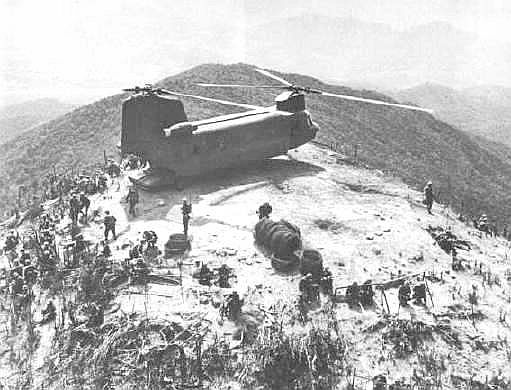
This is a 178th ASHC "Boxcar" Chinook on a mountaintop firebase LZ. (Uncredited photo "borrowed" from the 178th home page at http://www.boxcars.org/)
The ship was cranked up successfully, and we were off to Bronco. I thought that this is a bad start to my tour, and I only have 355 or so more days left. A short time later we arrived safe and sound at Duc Pho. In getting closer to Duc Pho, I saw that it wasn't right on the beach, but it was close enough for Government work.
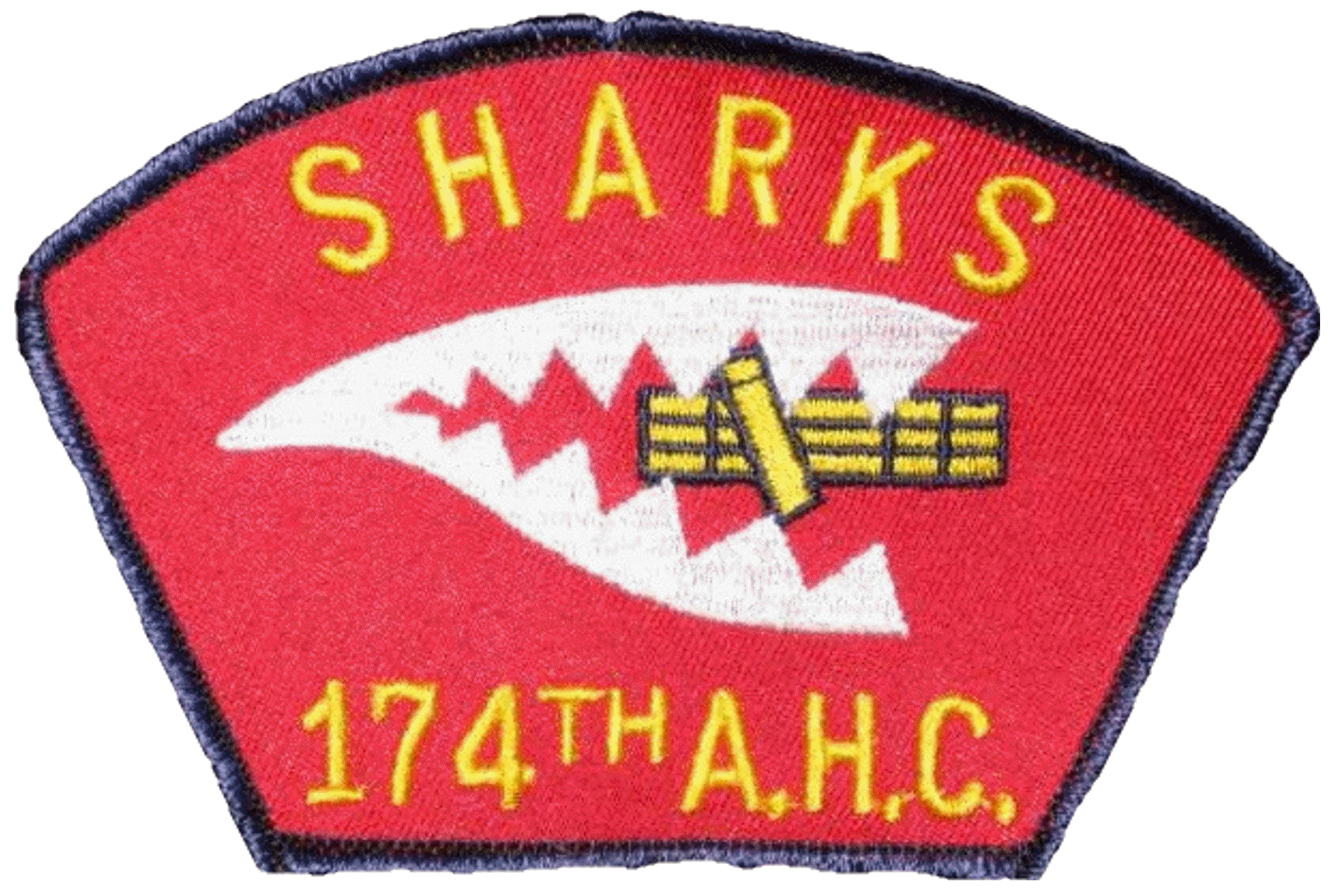
As the Chinook was landing, there was a flight of Sharks taking off on a scramble departure north on the flight line. The Sharks bounced into the air. I was surprised that Army aircraft would be painted the way the Sharks were. They had those red and white teeth wrapped
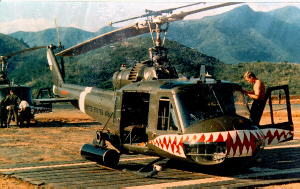 around the nose. The white tail fin. The Company stripe was on the tailboom and the access doors were painted with the logo of that particular ship. Pretty impressive. I was dropped off at POL (the refueling point) and walked to the 174th's Company area. I was assigned to the second Flight Platoon.
I was now part of the family known as the Dolphins and Sharks.
The 174th's Area of Operation (AO) ran to above Quang Ngai city to the north, the ocean to the east, the 2 Corp boundary to the south, and the Central Highlands to the west. The 174th supported the 11th Brigade, which consisted of Infantry Battalions of the 1/20 at LZ Liz NW of Bronco, the 4/3 at LZ San Juan Hill, the 4/21 which at the time was at an LZ SW of Bronco, and the 3/1 which if I recall correctly was at an LZ to the south of Duc Pho. We also supported the ARVNs (Army of the Republic of Vietnam soldiers) at Mo Duc and Quang Ngai city.
The first day I flew we were in the area of Quang Ngai flying Command and Control (also know as Charlie-Charlie or sometimes just C&C) for the ARVN's. We took fire. Being an FNG ("friendly" new guy), I didn't know what was going on and why all the shooting by the Crew Chief (I think it was Bud Van), and the "Taking Fire" call over the intercom scared the hell out of me.
Later in the week on a CA (Combat Assault), with "Mountain Yards" from the Special Forces (SF) camp at Ba-To we were putting the Yards in an LZ to the north of the camp. As the flight was lifting out of the LZ and climbing to altitude, one of the troops hadn't gotten off of ship, but was holding on to the skid underneath the gunner's well. Before the crew could get him into the ship, he fell to his death. When he hit the ground there was an explosion.
Since we were the trail ship, flight lead had us go down to retrieve the body. Our ship hovered above the area. I jumped out and recovered the body, which we returned to the SF camp. Apparently when he hit the ground, the LAW (Light Anti-tank Weapon) he was carrying exploded, which removed his head and upper body. The more I flew, I found that not getting off the ships, or hanging onto the skids, would get to be a pattern with the ARVN troops who didn't want to leave the ships when they were inserted into an area. I would get to dislike working with the ARVNs because of this.
I was finally assigned to fly on a UH-1H (I don't recall the tail number) with Armand Valley being the assigned crew chief. The next several weeks consisted of daily flying on CAs (Combat Assaults), C&C's, resupply missions, and LRRP insertions and extractions. LLRP stands for Long Range Reconnaisance Patrols. LLRPs were some really ballsy (or crazy) guys, doing some really ballsy (or crazy) things. The ships would take fire periodically, but I don't recall any other ships being shot down or crewmembers being shot during this time, other than the two Sharks that were shot down in the area of OD Lake where two crewmembers were killed.
On one of the CAs in the area of the Gaza Strip (which was north of Duc Pho and east of the town of Mo Duc), the 174th picked up a Company of ARVNs at Mo Duc. It turned out to be a hot LZ. We landed after the artillery and gunship prep. The ARVNs started to unload. I saw a green flash go by from the right to the left in front of the ship. My first thought was "they have fast bugs here." Everyone started firing and yelling "taking fire" over the radios. As my helicopter lifted out of the LZ, the pilot asked what was holding his seat belt. I looked on the cargo deck and saw an ARVN who had apparently been killed as we landed, and was lying on his back. He was still holding the back to the pilot's seat belt. My "fast bugs," I was told, were tracers. In my short time in the Army, the only tracers I saw were red. I wish someone would have said something about green ones before then.
Finally, Valley and I were assigned a new ship. It was a brand new UH-1H. It even had that new car smell. I think the number was 68-15567. The ship only had about 25 hours on it. Valley and I began to paint the Company white and blue stripes on the tailboom and had just gotten the white painted. That afternoon we were assigned to an extraction of 1/20th Grunts* from a rice paddy area to the SW of LZ Liz. If I recall correctly it was a three-ship LZ. The flight had been in a couple of times and we were on one of the last flight. We were the trail ship, landing and taking off from the north to the south.
We picked up to a hover. The flight started to take fire from the right from the tree line. Fire was returned by us doorgunners, and the Sharks started to prep the area. As we were hovering at about three feet, our engine apparently was hit. It seemed to stall, and the ship hit the ground.
I continued to fire.
I looked and saw that everyone else had gotten off the aircraft, with the exception of me and a Grunt that had been shot and killed and was lying on the cargo floor. Now, this was a clue that I needed to do something…stay on?…get off?… The hell with it... GET OFF!
I jumped off the ship with my M16 in hand and was lying next to the ship by a rice paddy dike. I fired the magazine I had in the weapon. OOPS no more bullets. I could hear bullets hitting the ship.
SHIT!
I got up and tried to grab the bandoleer I had tied to the seat. Of course I couldn't get it untied. I could hear the tink, tink of more rounds striking the ship. Another valuable lesson learned: If you don't have it on you, you probably won't take it with you.
I'm going to start a list of things to do in the future...
I grabbed the bandoleer the Grunt had along with my M60 and what ammunition I could carry. The remaining Grunts and three crew members (Valley, Lt Coakley I think, and an unknown pilot) were lying behind a dike about 25 yards to the left of the ship. They, at least, were smart enough to get away from a potential bomb carrying a thousand pounds of JP-4 jet fuel.
As I ran across the water filled rice paddy, I would sink up to about my knees in the mud with each step. I was finally able to get to the dike where the crew and the Grunts were located. As I fell across the dike into another water buffalo shit-filled rice paddy, the Grunt I was next to simply said, "That was neat". I asked him, "What?" He said, "As you was running across the paddy, that bullets were hitting around you and the water would splash up in the air just like in a John Wayne movie." Some movie! Where are my royalties?
* Incidentally, "Grunt" was a slang name given to the Infantry. I don't know where or how it was started, but I have nothing but respect for these guys.
The flight tried to get back in to drop off more Grunts and pick up the crew (us), but each time the flight tried to come in the fire increased. The flight was unable to land, even with the Sharks giving it everything they had trying to suppress the fire. Because of the fire, the Air Mission Commander (AMC) called for artillery support.
God knows how much firepower was expended, but eventually another flight of Grunts were brought into the area. By this time it was getting dark. We were running out of ammunition, and I wasn't looking forward to an overnighter without my blankee. The flight (I don't recall how many ships) finally was able to get in and drop off more troops, and to recover me and the rest of the crew.
Our Commanding Officer (CO), Major Goodin, was our savior. I was impressed. He could have assigned a junior officer to fly this dangerous mission-to get us out under fire--but he chose to personally fly in and get his crew out. I don't think the Grunts were too pleased to have to stay the night, expecially with our brand new (but now used and abused) helicopter, since it would be a target for the VC (Viet Cong) during the night. The next morning I was told that during the night that the VC had in fact been around our ship, and surprisingly enough the ship blew up. Every time I would fly in that area I would look at the only thing that was left of the ship, the tailboom with that new, bright, but unfinished white stripe.
Valley and I were assigned another new ship. This one was 68-15644. The AC assigned to this ship was WO Heisinger (sp?). Valley and I immediately got the company stripe and markings on the ship. We thought that only getting the job partially done was a bad omen because of our last experience, and we didn't want to tempt fate again. We then continued to fly our assigned missions.
I think the most satisfying flights were the extractions, taking Grunts out of the field, and the re-supply missions for the Grunts. Every time we would land at their logger position, they would come up to us as the ship was being unloaded and give us handfulls of mail. At the time I was wearing jungle fatigues, so I would stuff the mail in the pockets. By the end of the day I would look like the Pillsbury Doughboy with all the mail that I was carrying.
Sometime around June or July 1969, the 174th and the Blackcats (282nd AHC) from DaNang were involved in the largest CA that I had been involved in to this date. I don't recall the number of ships, but this assault involved the ARVNs to be inserted along the river west of Quang Ngai city. This area had been worked by the ARVNs prior to this. Our ship was in either the second or third lift into the LZ. Each flight would land from the west to the east, with a "break right" once out of the LZ. The lead flight consisted of the Blackcat aircraft.
As the lead Blackcat exited the LZ, they started receiving heavy fire as the flight was climbing. I watched the lead flight climb to altitude. The lead ship started to climb nose high, then rolled to its left, inverted with the nose down, and continued to roll and fall to the ground, killing the entire crew. As the ship rolled, one of the crewmembers fell from the aircraft. A pilot attempted to call lead on the radio to tell him that he had an aircraft going down. Another pilot simply said, "That was lead."
We continued to insert troops into the LZ but, on leaving the LZ we broke left over the river. We still took fire. I don't recall how many ships had been shot up or other casualties in this assault, but it was a bad day.
In August 1969, Dolphin 644 was assigned to a flight of Dolphin aircraft involved in a CA with 4/3 Infantry, to insert troops into an LZ in the "515 Valley" area. The flight was headed towards the LZ. Dolphin 644 was in front of the trail ship (second to last). The flight started to receive .51 cal. (anti-aircraft) fire. The trail ship, Dolphin 223, with a crew consisting of WO Shields, WO Bozinski, Sp4 DelValle, and PFC Graham, plus six Grunts had been hit, severing the tailboom. What a helpless feeling. All I could do was watch as the pilot tried to control the ship as it fell. The crew and all the Grunts were killed.
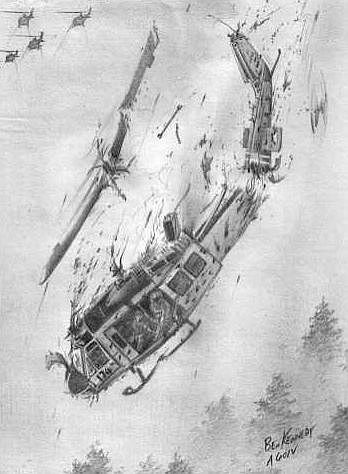
This is a dramatic pen-and-ink drawing by Ben Kennedy of
Dolphin 223 being shot down, that Tom witnessed.
The remaining Grunts were inserted, and they located the .51 cal and its gunner. The kid (I was told was 12 years old) had said that he had also shot down the Shark aircraft in the area of OD Lake earlier in the year.
Watching helicopters fall from the sky and friends being wounded or killed would become a common sight as I continued my tour.
Sometime in the summer/fall of 1969, a company of 1/20th Grunts ran into some larger booby-trapped mines or bombs just north of LZ Liz and close to Highway 1. Dustoff (a medical evacuation helicopter marked with the red crosses) had gone in to pick up the wounded. As the Grunts were bringing their wounded to the ship another booby trap was detonated, causing the Dustoff to overturn in the LZ. Several Dolphin aircraft were sent to the location to evacuate the wounded and dead from the LZ. We had made several trips between the LZ and the Medevac pad at Duc Pho.
During this summer and fall, I remember several times when we would pick up wounded from the Grunt units in the field, and that we would actually have to wait in line at the hospital at Duc Pho. The ships in front would offload the wounded and we would work our way forward in the queue to do the same, then we would go back and repeat this process for other units in contact.
The 3/1 moved into LZ Hill 411 around July or August 1969. This area would cause our Company several wounded or killed in the upcoming months. Dolphin 644 was assigned to a mission for 3/1. I didn't fly that day. Armand Valley was the crew chief. I think Scott Sparks was the gunner. Later in the morning, I was told that Valley had been shot and was taken to Evac Hospital at Chu Lai. The next day I flew to Chu Lai and visited Armand. He was in good spirits and had his million dollar "get to go home" wound. A short time later Armand was sent home. At that time, Armand had been in County for about four to five months.
It was sort of ironic. As I was getting a ride home from Chu Lai to Duc Pho and we were passing over Quang Ngai city, guess what? Green tracers were coming up to greet us from the city. Nice place, maybe I'll buy a condo there.
I was then assigned Dolphin 644 for the duration.
The 3/1 was assigned a new AO, and it had a particularly nasty section that was called the Horseshoe. I think this area had more NVA living there than there were in Hanoi. I seems like the 174th spent more time flying in this area than all the other areas combined, and you could always count on being shot at.
A flight of Dolphin aircraft were headed towards Hill 411 from Duc Pho to pick up a company of Grunts for a CA. The flight was just south of getting to the 3/1 area. There was an Air Cav unit, either the Blue Ghost or Warlords, headed west into the Happy Valley area. Their Blues, in a Huey, was at about the same altitude as us, and was crossing in front of our flight. Their transmission apparently seized up. The blades just came to a stop and the aircraft simply tumbled to the ground, killing the crew and the Blues on board. The area was secured with a load of Grunts, and we flew to Hill 411 to get body bags so the remains could be recovered.
Another day the 174th was to insert a company from the 3/1 into a CA at the south end of the horseshoe, in the mountains. The LZ was on a plateau and would accommodate 3 ships. This plateau had a drop-off of about 1000 feet at the north end of this particular LZ. The flight would land from south to north. The North Vietnamese Army (NVA) and the VC, in true fashion, allowed the first couple of flights to land and offload the troops. The next flight started to take .51 cal fire from the SW.
While the Sharks dealt with that threat, it was decided to land single-ship from the north to the south, with a shallow approach, to get the remaining grunts on the ground. Naturally there weren't any other sites that we could land at in the area. The wind was not in our favor and as we made the shallow approach to the LZ, there was a severe downdraft that was trying to suck the ship down the side of the cliff. We only partially made it onto the LZ.
Our front skids were on the edge of the cliff, with everything from the pilots seats back being in the air. As the AC (I don't recall who was flying that day) struggled to get the ship onto the LZ, the ship was bouncing on the edge. The Grunts (and yeah I admit I didn't want to be on this thing either) would look at the thousand foot fall, then look at me, the front skids bouncing on the edge within an arms
reach--but so so far away. Finally the AC was able to slide the ship over the edge, onto the LZ.
The Grunts unloaded, we picked up did a pedal turn, and departed back to the north. The AC let flight lead know that we had an overtorgue and we would be going to Hill 411 or Quang Ngai. Maintenance was contacted, and we shut down until the Witch Doctor (the 174th's Maintenance Officer) arrived. Dolphin 644 got its first free sling-ride home, compliments of the 178th Boxcars. I guess when the gauge is going around for the second time, and the needle is bent, that would qualify as an overtorque.
Dolphin 644 was repaired and was assigned to a re-supply mission for the 4/21 in the hills to the west of the rice bowl. As the ship was climbing to altitude, the Grunts on the ground called and informed us that we had a 105 mm artillery round on our left rear skid.
Say What?
These guys must be messing with us…BUT…maybe we should otta check anyway. So in taking a scrutinizing gander at the left rear skid, where the alleged round was suppose to be located….SHIT….There was a indeed 105 round dangling from the left rear skid. The round was hanging nose down with a loop of wire of some sort around the bottom of the round. This wire was looped around the end of the skid. Let's examine our options:
1 - It's a dud, ignore it. -- Nah, that won't work.
2 - Kick it! --Nah, another dumb idea.
3 - Land or hover and have someone take it off. -- Problem: to find a volunteer, then hope it doesn't go bang when it's touched. Nah, that might not be the best solution either.
4 - Maybe it will just fall off on its own. -- Nah, not likely.
5 - Someone will have to climb out on the skid while we hover at altitude and cut the wire. -- Huh?? -- OK, OK, sir, I get the message!
I got a pair of cutters, and when the ship was at a hover at about 1000 feet, I stepped out onto the skid while holding onto the gun rack. I found that the round looked fairly old, a dud?…so far at least… And it wasn't a wire. When the round was fired, it shaved off the end of the round, and that "shaving" was partially attached to the end of the round. Apparently, as the ship lifted from the LZ, the rear of the skid dug in the dirt and the round hooked onto the skid. In any event, the metal cut fairly easily and the round fell the thousand feet to the ground. We continued our mission.
OK gang, it's time for a quiz: The question is... Is it possible to fly a UH-1H underneath the Quang Ngai bridge?
The answer is... Yes.
One sunny day while flying a MACV C&C... Naw, never mind. Better not tell -- think I'll just move on.
In November 1969, Dolphin 644 was on another MACV C&C, and we had flown to Chu Lai. We were sitting on the maintenance pad when a Dolphin first platoon ship landed. I think they were either on a 3/1 C&C, or re-supply. I spoke to Forrest Hodgkin briefly. His ship was using free guns--M60's without gun mounts. I don't know why they didn't have gun mounts like all of the other Dolphin aircraft, but they didn't. They left Chu Lai on their mission. Later that day, we were told that they had been shot down in the Horseshoe area on a re-supply mission, killing the crew consisting of Hodgkin, WO Wilson, WO Regaldo and Sp4 Ducommon. I often wondered if not having visible guns on the ship may have contributed to their shoot down.
Finally I was assigned to the Sharks.
This was all right! I LIKE flying close to the ground. I always knew I was afraid of heights. Flying in the Sharks was some of the most interesting flying I had been involved in. The Sharks used UH-1C Charlie models like Loaches, flying low and slow... getting right down there with the Grunts. Of course this did have its drawbacks...
While were covering a Dolphin spray mission (can you say "Agent Orange?") west of San Juan Hill, and as the Dolphin was making its spray runs, our ship started taking fire from the right. Jeff Zavalas was the AC. Before we could make a turn to return the favor, our wing ship told us we were leaking fuel. The fuel gauge was dropping like the Titanic. A quick check out the door confirmed we had a problem. There was fuel streaming down the right side of the aircraft onto and over the right side rocket pods. The fuel was flowing at approximately the same rate as Niagara Falls. Since the mission was close to the Special Forces camp at Ba-To, we headed that direction, hopefully before the ship ran out of fuel. Once at the Special Forces camp, the ship was shut down and it was determined that a round had cut a fuel line in the engine compartment. I bet that would have been some sight if we hadn't been told about our leak and we touched off a rocket or two. As it turned out, we got another free ride home by the 178th.
The Happy Valley area was always a good place to troll for something to kill. Flying low and slow, the ship turned sharply. On this particular flight, I thought we had a tailrotor failure as the old Charlie Model REALLY banked over hard. I looked to the right and saw that Scott Sparks was leaning out the right cargo door and was holding onto the door itself. The door hadn't securely latched, worked its way forward, and the wind pushed it out where it was caught by the minigun mount and frame, causing a large, one-sided airbrake. The ship was pulled to a hover, and as Scott and I got the door secured, some enterprising NVA/VC took a shot at us. We were in no position to return fire. Luckily, the only damage we suffered from this was the bent cargo door, which was replaced.
Speaking of the Happy Valley, this is the only time that I know of where a Shark aircraft was used to medivac a wounded ARVN. A Dustoff was sent to the area and the Sharks were requested to provide cover. The Shark team was already in the area, but the Dustoff wasn't. Both Sharks were low on fuel. Capt. Mike Ackerman, Shark 6, found that the unit hadn't had any recent contact. Ackerman told Dustoff that we would make the medevac himself because of Dustoff's location and our fuel shortage. While the wing ship covered the area of last contact, Ackerman landed and medivaced the ARVN.
Photo below: Fred Thompson, flying as Captain Ackerman's wingman, took these photos of Shark 6 as Ackerman conducted his "Armed Dustoff Medevac."
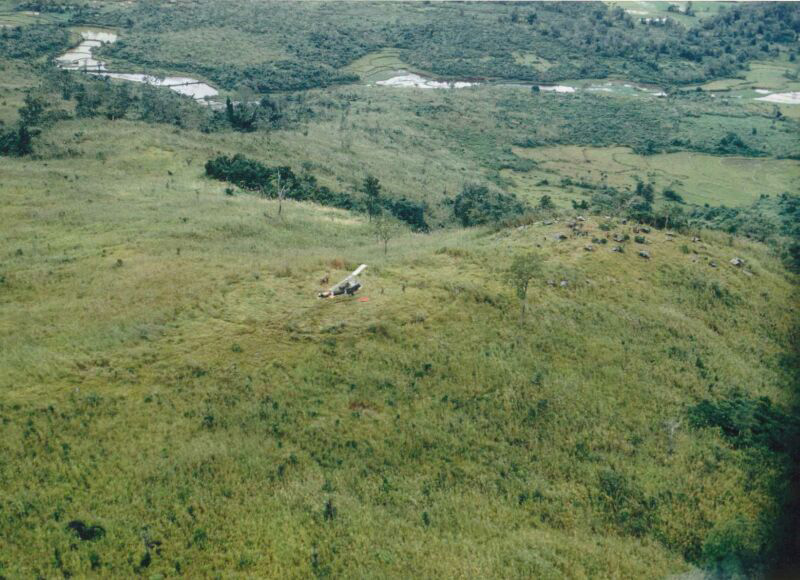
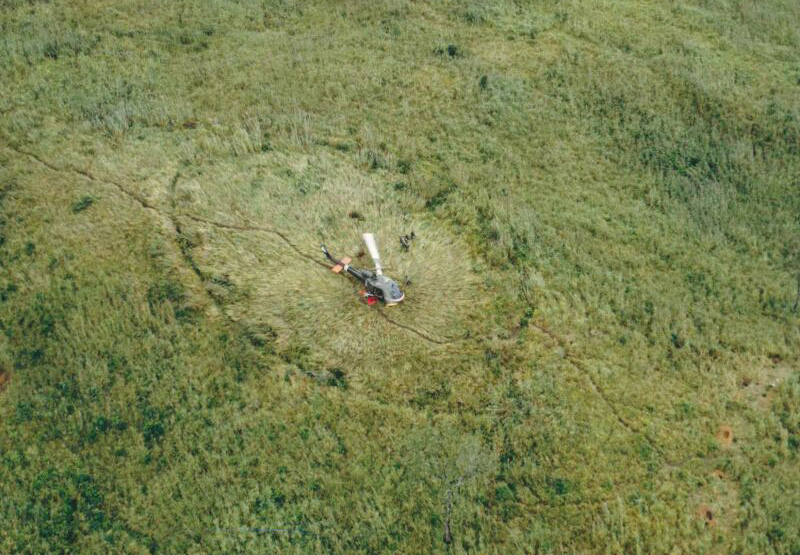
Captain Mike Ackerman, our Platoon Leader, always radiated confidence and professionalism. He was one of those guys that had an aura around him that--when I was flying with him--I always felt that nothing bad would happen to me. He was flight lead flying in Shark 540 on an extraction of Grunts from the 1/20th from the mountains NW of LZ Liz. When I walked out to the ship, prior to the mission, he ask why I wasn't wearing a cap. I don't recall my excuse, but he told me that when we returned from this mission, for a week, I would have to wear my flight helmet whenever I was outside. My fate was cast. As we were covering the Dolphins making the extraction, I saw some people moving around in the lower hills to the south of where the Grunts were being picked up. I told Ackerman about this. As he was checking to see if there were any friendlies in that area, he flew down to where I observed the people. We started taking fire. Well, that answered the question of whether they were friendly or not. The extraction became an impromptu CA. At the end of the day, Ackerman told be that I didn't have to wear my helmet as he had earlier ordered, thanks to finding the "unfriendlies." But I did need to start wearing the cap.
Anyone ever hear of a Lizard Dink? The lizards in Vietnam grow larger than some of the people. When in the water, you could see where they were because they would stir up the mud on the bottom. While working the Horseshoe area and flying over the river, we noticed that the mud was being stirred up. "Must be a lizard." "You sure?" "Not really." So a concussion grenade was thrown in the water, just to be sure. The ship circled waiting for the explosion, and for the unlucky lizard to surface.
BOOM!
YIKES! I didn't know lizards had AK-47s.
After a quick burst from their AK's, they died. The three NVA/VC soldiers were found to be paymasters, apparently delivering money to the troops. Sorry, no boom-boom for Uncle Ho this month.
If you call getting merely wounded as lucky, then WO Jim Kinne is probably the luckiest man I've seen when it comes to being shot. I think he was shot three times while flying with the Sharks, two of which were in the Horseshoe. I don't recall for sure, but maybe all three times were in the same area.
Kinne was flying in the foothills just south of the Horseshoe. We received fire, hitting Kinne in the left hand. I'm not saying we were low but I think the barrel of the dink's gun bounced off the skid and his brass ended up in the ship. The second time Kinne was shot is notated in Fred Thompson's biography.
Another quiz: The question is... Does a OH6 Loach need a pilot or crew to maneuver around a rice paddy?
The answer is... No.
On completing a mission for 3/1 and returning to Duc Pho, from the north, there was an Air Cav unit circling one of their Loachs which was on the ground. I don't recall if it was the Blueghost, or Warlords, or who. The Loach was in a water-filled rice paddy sorta hovering, almost, by itself without the crew. The crew was trying to get into the ship to get it grounded. It was a strange sight to see an OH-6 sliding around the paddy, bouncing off the dikes like it was playing bumper cars, with no one flying it. The Crew was finally able to get this wayward ship under control. I never did hear how the Loach went AWOL, but it had probably been "frictioned-down" and the friction on the controls loostened up.
I was out on the flight line one day working on Shark 540, the Grim Reaper. This particular morning, the primary team was scrambled for a unit in contact south of Mo Duc. Both Sharks were cranked and ready to go, but one of the ships was missing the crew chief. I went over and got into the ship, and as we were about to lift off, the crew chief arrived. I told the crew chief, Yogi Reeves, that I would go ahead and fly for him. He said OK. Yogi was from the Atlanta, Georgia area... the damn Rebel probably got lost in the holler or something on the way to the helicopter. We arrived in the area of contact, and as it was being prepped by us, I was hit in the shoulder by something. It didn't really hurt. I reached over and touched my shoulder. It was wet and gooey. My first response was, "SHIT!" I then looked at my hand and shoulder…MUD…When a rocket was fired and hit the dike it kicked up some mud and we were so low that it hit my shoulder. So much for my Purple Heart!
Fred Thompson spoke of rearm specialist Timothy Jeome "Shadow" Spencer. Well, there was another specialist who worked in rearm also. I don't recall his name but his nickname was "Bean." Bean was Hispanic, and was from Michigan or Minnesota. Bean would call us caucasians a "bunch of white bananas." Both these guys did an excellent job of keeping rearm completely stocked and helped with loading each Shark when they returned from a mission. Well, Bean wanted to fly, so one day the Sharks were to cover an extraction for the 4/21, SW of Duc Pho in the Rice Bowl area. This was another one of those "It's suppose to be a cold extraction" missions. Of course Murphy's Law took over, and Bean's cold flight turned out to be a hot one. They took fire, and a round struck the mike cord coupling on the AC's helmet, severing the coupling. This was about three feet in front of where Bean was sitting. I think he'd had enough, as I don't recall Bean wanting to fly any more after that.
The longest distance I flew on a scramble supporting a unit in contact was the day a team of Sharks were sent NW of Tam Ky, where it was reported that an entire flight of the 71st AHC Rattlers had been shot down in an LZ. Tam Ky is NW of Chu Lai. The Sharks flew to Chu Lai, refueled, then continued to the LZ.
Low leveling towards the area, we flew over several NVA running towards the battle. We were going to engage them, but were told to continue to the LZ. When we got to the area, I saw that the flight of three or four helicopters were sitting in the LZ with the blades displaced and not running.
We took immense fire from the area. My little green bugs were flying all over the place.
We exchanged fire until the bugs went away. In addition to the AMC and other slicks in the area, there were about six to eight gunships from the 71st Firebirds, 176th Muskets, and the Sharks. I don't recall how many times we would return to Tam Key to refuel and rearm, but we stayed in the area until the 71st was able to get enough people in to secure their people and aircraft.
I'll give you guys reading this a clue. Never--mean NEVER--attempt to insert a LRRP Team into a NVA base camp! This has some dire consequences for the crew and LRRPs. Our Shark team was covering a G Company, 75th LRRP team insertion to the SW of San Juan Hill. We were staying out of the immediate area of the insertion. The low Dolphin was dropping off the LRRPs when they started receiving fire, and the Dolphin was shot down in the LZ. The AC was Lt. William Smith. You could hear the desperation in his voice as he said they were hit and going down. We arrived in the area to cover the recovery of the LRRPs and crew. I don't recall if the ship was recovered or not, but what really sticks in my mind is call for help from Smith. When I was in the second platoon, I always liked the LRRP insertions and extractions, and mainly in being the low ship. I don't know why I enjoyed these types of missions so much, as they were certainly high risk missions.
I had flown with Lt. Smith in the Dolphins. I think he was a Yankee from the New York area, based on his accent. He had another mis-adventure in my old ship, Dolphin 644. I don't know if they were returning from the 4/3 area or working the 1/20 area, but they called in a "May Day" as they were going down in the foothills west of LZ Liz. Apparently there was a lot of strange noises coming from the transmission area, and it was spitting out parts like shit through a goose. They did an emergency landing, and the Sharks and Witch Doctor were sent out the cover the ship and crew. Old 644 was rescued again by the Boxcars from the 178th ASHC and got a free ride home on the end of a rope.
Towards the end of January 1971, the 174th was told that we would be moving, but not told where. Mouse, one of our hootch maids who had worked for our Company since I arrived in April 1969 came up to me and said, "Taggart, you lifer, you been in Vietnam forever." I told her "no, I'm a short timer." She said "No, you lifer, you go to Laos, you die." With that vote of confidence, I couldn't wait to find out where the 174th was headed. Just after this, the 174th loaded up and headed northbound, with the ultimate new base being Quang Tri, to work in Laos just like Mouse had said. I should have talked to Mouse more about this since she seemed to be in the know of what we would be doing. About this same time, I was talking to John Moore. As I'd been in Vietnam since 1969, he started to laugh and told me that I would be in Vietnam longer than he would be in the Army. I think he was jealous.
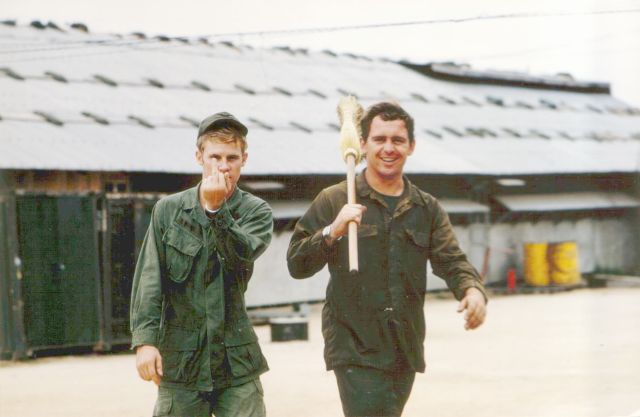
Tom is the guy with the broom. The 174th mess hall is in the background. John (the Finger) Moore had his heal blown off in Laos. That portion of his foot and his boot heel landed in Pat Wade's ammo can...
(Dec '70 at Duc Pho, photo by Fred Thompson)
Once the 174th arrived at Quang Tri, we were housed at an abandoned orphanage some distance from the flight line. This was hard to get used to because at Duc Pho the flight line was within spitting distance of the hootches. Most of the company, with the exception of the officers, were in the old orphanage building. The officers were in tents around the outside of the building. Not bad, since it was in, out of the rain.
I never thought that I would be cold in Vietnam, but it was winter, and monsoon season, and everything stayed wet. Quang Tri was just COLD! The continual rain made things more uncomfortable, especially when you had a hundred-mile-per-hour wind hitting you in the face when you were flying as a crew chief or gunner on a gunship, it would chill you to the bone.
The first few days that the Sharks flew up to Khe Sahn, it was spooky. It was so quiet. There was no movement or contact with the NVA. I think this was more unnerving than anything else. As the days passed, traffic on the one main road into Laos (QL9) increased, as did the missions.
Then Lam Son 719--the Ultimate Romeo Foxtrot (RF)--began.
Flying in Laos was a bit different than in Vietnam. You almost got to pick what you wanted to be shot at with, depending on what altitude you were flying at. The Sharks began with covering the various flights of Dolphins. To confuse the NVA listening to the frequencies (yeah, right!) our callsign was changed to "Boats" for this operation, as well as other helicopter companies inserting Grunts into LZ's around Khe Sahn, Vandegrift and the Rock Pile. Very soon we were flying the ARVNs into Laos.
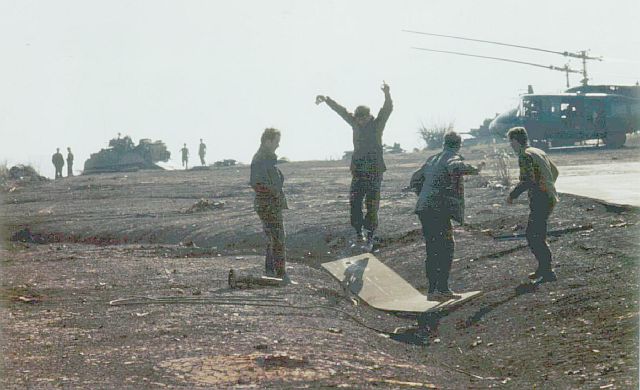
Photo below: "The Teeter-Totter" at Khe Sahn (or, how to use a war zone as a playground). Sharks on standby, February 1971. Taggert is on the left, then Bill Wilder (in air), then Gary Munson, and an unknown Shark crewman on the right (possibly
Ray Earvin). Photo by Fred Thompson.
About two-three weeks later, the Sharks were assigned to Dustoff cover. I've never seen so many aircraft of every description, both Army and Air Force, in the area at the same time, flying in different directions. Then you had to make sure that you didn't stray into the path of the Arc Lights (B-52 strikes). From watching both the lift ships and Dustoff aircraft, I felt sorry for the crews that had to deal with the ARVN flights. Time and time again, as the ships would either insert or extract the ARVNs, there would be several of the troops that wouldn't get off the ships, or would hold onto the skids. Sometimes, on extractions, so many would climb onto the aircraft, they'd make it almost impossible to take off. Then you would have to factor in the ground fire of every caliber and mortars landing in the LZ or PZ. Not a pretty place to be. Because of this I'm surprised that casualties among the aircrews wasn't higher than it was.
Fred Thompson has documented a lot of the events of that time with the 174th in his biography, so I won't go into what he has already covered, but will add a few incidents.
At the 174th's old AO of southern I Corp (Duc Pho area), I had flow over and around the area so much in the last almost 2 years that you could take me out blindfolded, show me a tree, and I could practically tell you where I was. Not so in Laos. There were several times that once in Laos, with all the yanking and banking to get out of contact with the intense ground fire, and keeping in eye contact with the aircraft you were covering, that the entire crew would become disoriented. And with us being so close to North Vietnam, you couldn't simply fly east to get home. I was fortunate not to become a "criminal" like Fred and other members of our company who actually spent time on the ground in Laos, against Presidential Orders.
On a Dustoff cover west of either LZ Ranger North or Ranger South, I was on a Hog ship (which has a 40mm on the nose and 19 shot rocket pods on each side). This thing is nose heavy on a good day, and because of the weight it wasn't very responsive to quick movements. Dustoff had picked up a load of wounded, while being bombarded by mortars, and was climbing out. The Shark team was following Dustoff at a lower altitude, when we started to receive fire. One of the first rounds came up through the console, taking out the armament panel. We were unable to fire the rockets or the mike-mike (40 mm). As the ship slowly climbed we continued to take ground fire. The only protection the ship had was our door guns, and man were we using them.
The area could best be described as being in the bottom of a bowl, where you would have to climb to get to the top of the bowl. A Hog ship climbs like a rock anyway, only slower. Every time our direction would change, more ground fire was received. The lead Shark would follow the Dustoff out, but we couldn't climb fast enough to follow. We were left alone to work ourselves out of this predicament.
Finally, no more door guns. Ammo expended. To lighten the load, all of the 40 mm ammo from the cargo compartment between the crew chief and gunner was thrown out. We tried to jettison the rocket pods, but they wouldn't manually release. Finally we were able to climb where we BARELY cleared the trees, at the top of the mountain, by dragging the skids through the tops of the trees. On the other side of the mountain was a large valley where we headed back to the relative safety of Khe Sahn. We were lucky that there weren't any NVA on that mountain top or our ship wouldn't have made it back, since the only firepower left were our personal M16's and sidearms.
Laos!
I think the powers-that-be either forgot, ignored, or lied about what the aircrews were in for. We, Army Aviation, were not prepared for or equipped for it, nor did we have the tactics for the realities of Laos. All aircrews were familiar with the hazards of flying in Vietnam, to some degree, depending on the amount of time or tours that each has spent in country. I had been in country since 69 and this little ADVENTURE was unbelievable. The amount of fire and the persistence of the NVA, not like in Vietnam, to hit and run, was incredible. They meant to stay, and the NVA let us know that by their persistence and firepower.
I finally went home in March of 1971 after, of all things, being injured in a traffic accident on the flight line in Quang Tri. My knee had gotten infected, and since I was short (less than a month left) I was sent home.
I didn't have contact with anyone that I had flown with during my time with the 174th until 1984, when Jim Shedd (CE in 1969) called me. I hadn't heard his voice since 69. I immediately knew who I was talking to. Jim was arranging a mini-reunion with other members of the 174th in Dallas, Tx. I told him I would be there. At this reunion, besides Jim and I, were Robert Shoe, Bill Loken, Tucker, John Bond, Gary Mack and Tom Arnold. We all told lies and caught up on our lives since that time. I hadn't really talked about my experiences since getting home in 1971.
After returning home from the reunion, I found some old paperwork (including some orders) from that time period. In 1993 I received another call. Again I recognized the voice of Fred Thompson. He told me that he was in the process of locating as many members of the 174th as possible. I gave him copies of what I had. I also met Fred and several members of the 174th at the VHPA/VCMA reunion in Phoenix in 93. I hadn't seen any of these guys since 69 to 71. Since that time, Fred or Jim McDaniel have put me in contact with Bob Jansen and Bud Van, and just recently I spoke to Armand Valley.
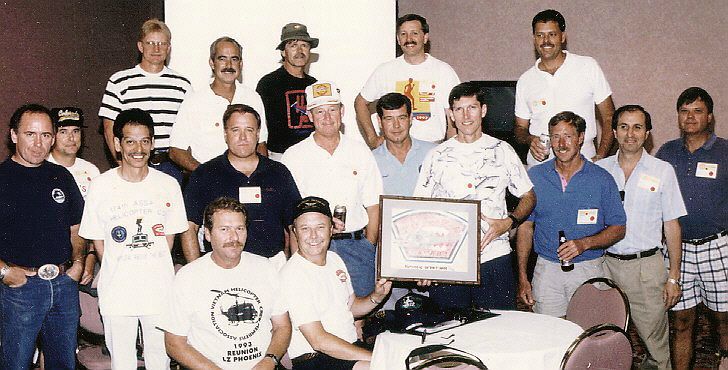
Above, several 174th members at the 1993 Phoenix reunion. Tom Taggart is at the far left with dark T-shirt and cowboy belt buckle. To see another photo from Phoenix with 32 crewmembers and pilots, see http://www.americal.org/174/phonex-1.htm. In this second photo, Taggart is second from the left on the top row between Danny Davidson and webmaster Jim McDaniel.
I was surprised by the number of guys I flew with that got into the same profession as I had, Law Enforcement. I became a Police Officer in Billings, Montana in 1973. I have also worked for the Wyoming Highway Patrol, and finally with the Yellowstone County Sheriff's Office, Billings, Montana where I retired in 1998. While with the Sheriff's Office, I was in charge of a Task Force based at the DEA (Drug Enforcement Administration) office in Billings. Through that position, I ended up working several investigations that took me to Los Angeles, California. As luck would have it, this is where Fred Thompson lives. On each trip to LA I would either call Fred or meet him. Fred also was in Law Enforcement and has retired from the LAPD. I don't know if it's the same with other Assault Helicopter Companies to have a large number of their people doing the same type of work after the military. I think it has to do with the adrenaline rush of flying in combat and that unknown. Police work has the same type of unknown and rush we adrenaline junkies need.
When I spoke to my mother, God rest her soul, about these reunions, she would ask me why I will travel across country on short notice to visit these people I only knew for a short period of time, when I haven't been to any of my high school reunions with people I had grown up with. I told her that I have more in common with friends from Vietnam and Laos, who I knew from only one month to a year, than I do with people I grew up with. There's that bond between these guys, which for me is stronger than any childhood friend. That fear of dying, and the trust and confidence that builds from knowing that the only people that can and will help you survive are your crewmembers and wing ships.
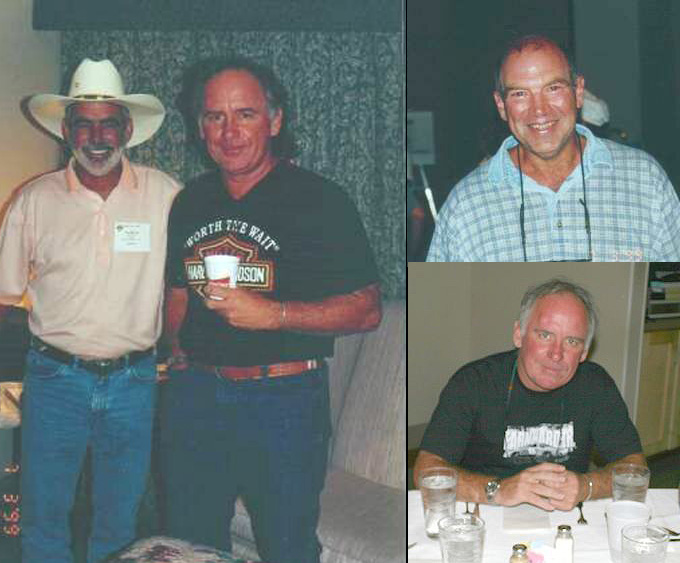
On the left is Yogi Reeves with Taggart in the middle. Bruce Marshall is in the far right photo. (Photo from Fred Thompson.)
How do I sum up my experiences with the 174th? I respect each and every member of that organization. At the time Cobras were fast, sleek and armed to the teeth. But we didn't have any of those. To see a Charlie model gunship from the ground, low level, painted with that "please shoot at me" wrap-around grin, with its miniguns and rocket pods, reminds me of a pitbull.
That old Charlie model may be slow and fat, but it had attitude. Most of it bad. I think the NVA/VC saw that same attitude, which could only be personified by the crews that flew them. The crews that flew the slicks deserve the most credit and respect, since they dealt with the day-to-day challenges of simply surviving the hostile environments of re-supply, CAs, C&Cs, LRRP insertions and extractions, etc., both in Vietnam and especially Laos.
And the unsung heroes who made it all happen were the maintenance folks, rearm, armament, avionics, clerks and the rest of the support group who, without their efforts, the 174th wouldn't have been the unit we were.
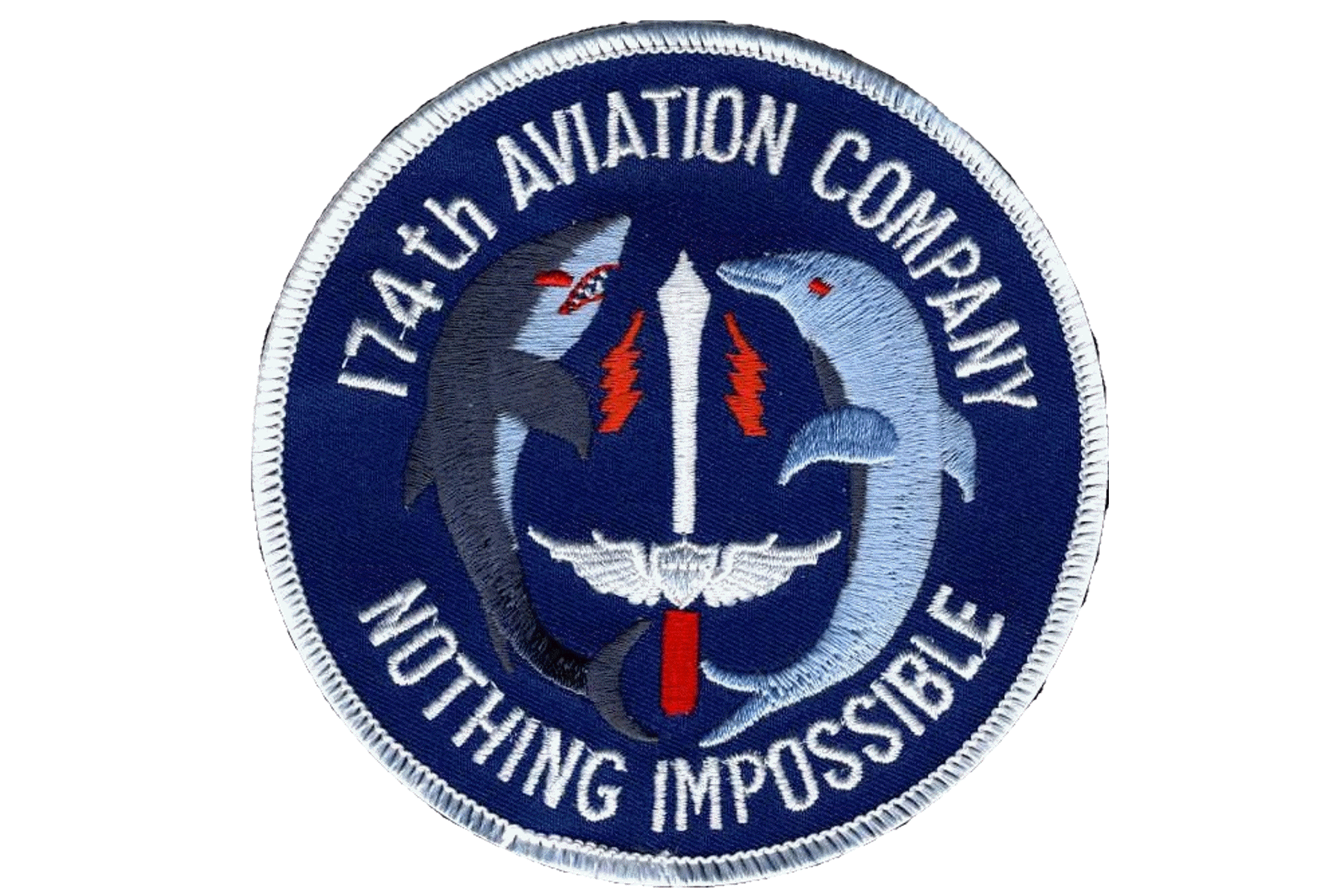
The military has its pecking order, which I understand, but in combat no one cares what rank you are--you do what you have to do to save your crew/team, and that's what impressed me most about the 174th. It was a team effort. The 174th motto: "Nothing Impossible" says it all.
I have to apologize for not having the names of all the crews and support people I have known. If I had known I was going to live this long I would've kept a diary. I have flown with so many different pilots, crew chiefs and gunners, that after awhile they all blend together. If anyone can fill in the blanks for the above events either let Fred Thompson, Jim McDaniel, or myself know.
Love ya all,
Taggart
-----------------------
Tom Taggart
788 Senora Ave.
Billings, Mt 59105
hm 406-896-0194
wk 406-256-6861
cel 406-670-4881
e-mail: TTaggart@co.yellowstone.mt.us
|
 Click here
 Return to top of the Biography Page.